

CARDIOPULMONARY RESUSCITATION (CPR)
Cardiopulmonary resuscitation, otherwise called CPR is an emergency lifesaving technique that is used in emergencies where an individual’s breathing or heartbeat has stopped. Some of such emergencies include drowning, choking, heart attacks, etc.
Thank you for reading this post, don't forget to subscribe!In emergencies where breathing ceases or the heart stops beating, the supply of oxygen and blood to the brain and other vital organs is reduced or stopped and this can cause death in as short as 5 minutes. CPR will help to sustain the flow of oxygen and blood to the vital organs till appropriate medical intervention is done.
Before starting CPR,
– Remove the person from danger (for example from a car crash to a safe space), and remove tight clothes around the neck and chest.
– Check to see if the person is conscious or unconscious: If the person appears unconscious, tap or shake his or her shoulder and ask loudly, “Are you OK?”
– If the person doesn’t respond, call for help and begin CPR.
How to perform CPR.
To perform CPR, use the step called C-A-B.
C stands for Compressions
A stands for Airway
B stands for breathing.
Compressions: This is to restore blood flow.
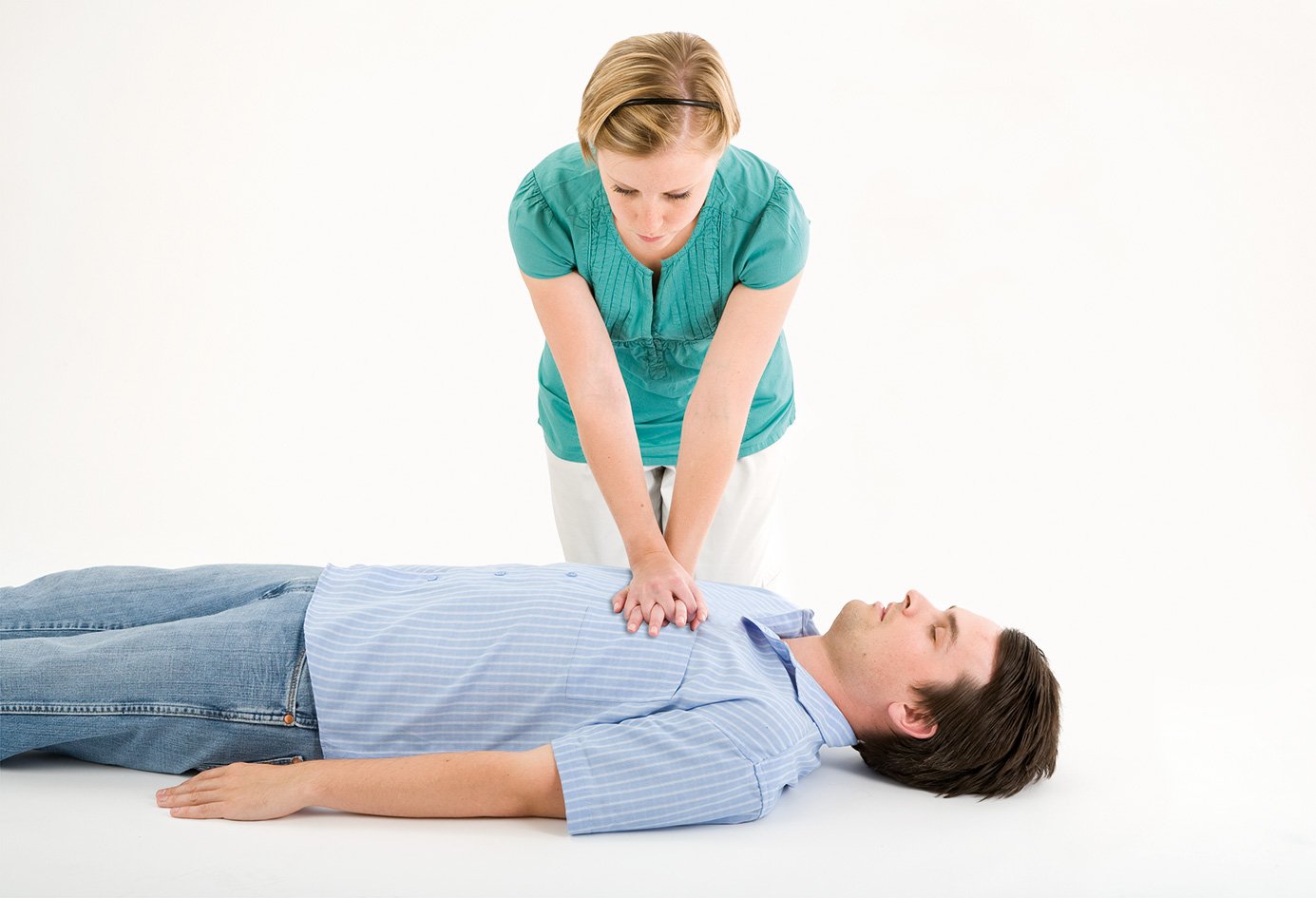
To perform compressions, you’ll use your hands to push down hard on the person’s chest. Compressions are the most important step in CPR.
Steps for performing CPR compressions:
– Lie the person on his or her back on a flat surface.
– Kneel next to the person’s neck and shoulders.
– With one hand, place the heel of your palm over the center of the person’s chest, between the nipples.
– Place your other hand on top of the first hand and interlock your fingers. Keep your elbows straight.
– Press down on the chest at least 2 inches. Use your entire body weight (not just your arms) when doing compressions.
– Push hard at a rate of 100 to 120 compressions a minute. Allow the chest to spring back after each push.
If you haven’t been trained in CPR, continue chest compressions until there are signs of movement or until emergency medical personnel take over or you get to the hospital. If you have been trained in CPR, go on to opening the airway and rescue breathing.
Airway: This step is to open the airway.
If you’re trained in CPR and you’ve performed 30 chest compressions, open the person’s airway using the head-tilt, chin-lift maneuver. Put your palm on the person’s forehead and gently tilt the head backward. Then with the other hand, gently lift the chin forward to open the airway.
Breathing: This is to help the person breathe.
Rescue breathing can be mouth-to-mouth breathing or mouth-to-nose breathing if the mouth is seriously injured or can’t be opened.
– After opening the airway (using the head-tilt, chin-lift maneuver), pinch the nostrils shut for mouth-to-mouth breathing and cover the person’s mouth with yours, making a seal.
– Prepare to give two rescue breaths. Give the first rescue breath — lasting one second — and watch to see if the chest rises.
– If the chest rises, give a second breath.
– If the chest doesn’t rise, repeat the head-tilt, and chin-lift maneuver and then give a second breath. Thirty chest compressions followed by two rescue breaths is considered one cycle. Be careful not to take too many breaths or to breathe with too much force.
– Resume chest compressions to restore blood flow.
– Continue CPR until there are signs of movement or emergency medical personnel take over.
Performing CPR for a child.
For a child above 1 year, the procedure is essentially the same as with adults. But, you may use the heel of one hand only if the child is small. Compressions should be less hard than for an adult to avoid fracturing the breast bone.
For children less than one year:
Cardiac arrest in babies is usually due to a lack of oxygen, such as from choking. If you know that the baby has an airway blockage, perform first aid for choking. If you don’t know why the baby isn’t breathing, perform CPR.
– Touch the baby and watch for a response, such as movement. Don’t shake the baby.
Follow the compressions, airway and breathing (C-A-B) procedure for a baby under age 1 except newborns, which include babies up to 4 weeks old.
– Place the baby on his or her back on a firm, flat surface, such as a table or floor.
– Place two fingers of one hand just below the nipple line, in the center of the chest.
– Gently press down to about 1.5 inches.
– Count aloud as you push down. You should push at a rate of 100 to 120 compressions a minute, just as you would when giving an adult CPR.
Airway:
After 30 compressions, gently tip the head back by lifting the chin with one hand and pushing down on the forehead with the other hand.
Breathing:
– Cover the baby’s mouth and nose with your mouth.
– Prepare to give two rescue breaths. Use the strength of your cheeks to deliver gentle puffs of air (instead of deep breaths from your lungs) to slowly breathe into the baby’s mouth one time, taking one second for the breath.
– Watch to see if the baby’s chest rises. If it does, give a second rescue breath. If the chest does not rise, repeat the head-tilt, and chin-lift maneuver and then give the second breath.
– If the baby’s chest still doesn’t rise, continue chest compressions.
– Give two breaths after every 30 chest compressions. If two people are performing CPR, give one to two breaths after every 15 chest compressions.
– Continue CPR until you see signs of life or until medical personnel arrive.


